adaptible
Adaptible
A small language model that keeps its conversations and retrains itself on its own corrections, on a laptop.
Deployed language models are frozen: they answer, forget the exchange, and
answer the same way tomorrow. Adaptible wraps a 1.5B reasoning model
(DeepSeek-R1-Distill-Qwen-1.5B) in a server that records every turn,
revisits its past answers when idle, rewrites the ones it now thinks are wrong,
and fine-tunes LoRA adapters on the rewrites. It runs on Apple Silicon through
MLX; the self-repair loop also runs on a CUDA GPU through PyTorch.
The model is small on purpose. A frontier model given a correction would absorb it, and that would show nothing about the mechanism. A 1.5B distilled reasoner gets basic facts wrong, loops inside its own chain of thought, and has weights entangled enough that one update moves unrelated facts. Every failure mode of self-training is visible at this scale, so any lift that appears is informative.
How it works
The server answers prompts and stores every turn, user and assistant, in memory and in SQLite. Nothing is discarded, so a mistake made at noon can be examined at midnight.
On request or on a schedule, the model is shown its past exchanges and asked to pick a response it could improve and rewrite it. The rewrite must address the right turn, be a plausible length, and not be degenerate; otherwise it is discarded rather than trained on. Each accepted rewrite becomes one training example, the original prompt followed by the new answer, with a loss mask that is zero over the prompt and one over the rewrite. Only LoRA adapters on the last few layers receive gradients, so an update is small, cheap, and reversible.
A model this size produces training targets that are wrong, or right for the wrong reasons, more often than not, and a bad update can erase facts the model already had. The self-repair loop therefore never trusts a target. It samples candidates from the model’s own reasoning, trains a few steps, regenerates the answers to the original question and to paraphrases of it, and keeps the new weights only if those answers improved. Otherwise the weights are restored from a copy and the next candidate is tried. An update survives by changing what the model says, not by lowering a loss.
Reasoning models this size also loop: they repeat a sentence, or circle inside their chain of thought and never answer. Generation carries two loop breakers, and a generation that never reaches an answer is judged wrong, so the loop cannot be satisfied by a model that has stopped answering.
Conclusion
On five facts the model gets wrong, each tested in four phrasings it never
trains on, the self-repair loop lifts accuracy from about a quarter of the
prompts to three quarters or more within ten to sixteen cycles, in five runs
out of five. The model stays a reasoning model while it does so. What happens
after the lift varies from run to run: the score can hold, drift, or in one
run fall back as the model starts looping. Run as a served node with nothing
but a thumbs-down and a document store to consult, the same loop repairs
three of the five facts by the second session and the patches survive a
restart; over sixteen sessions later repairs then start to undo earlier ones,
because the node checks its own control prompts but not its earlier repairs.
The write-up, with the data behind each number, is in
results/.
Demo
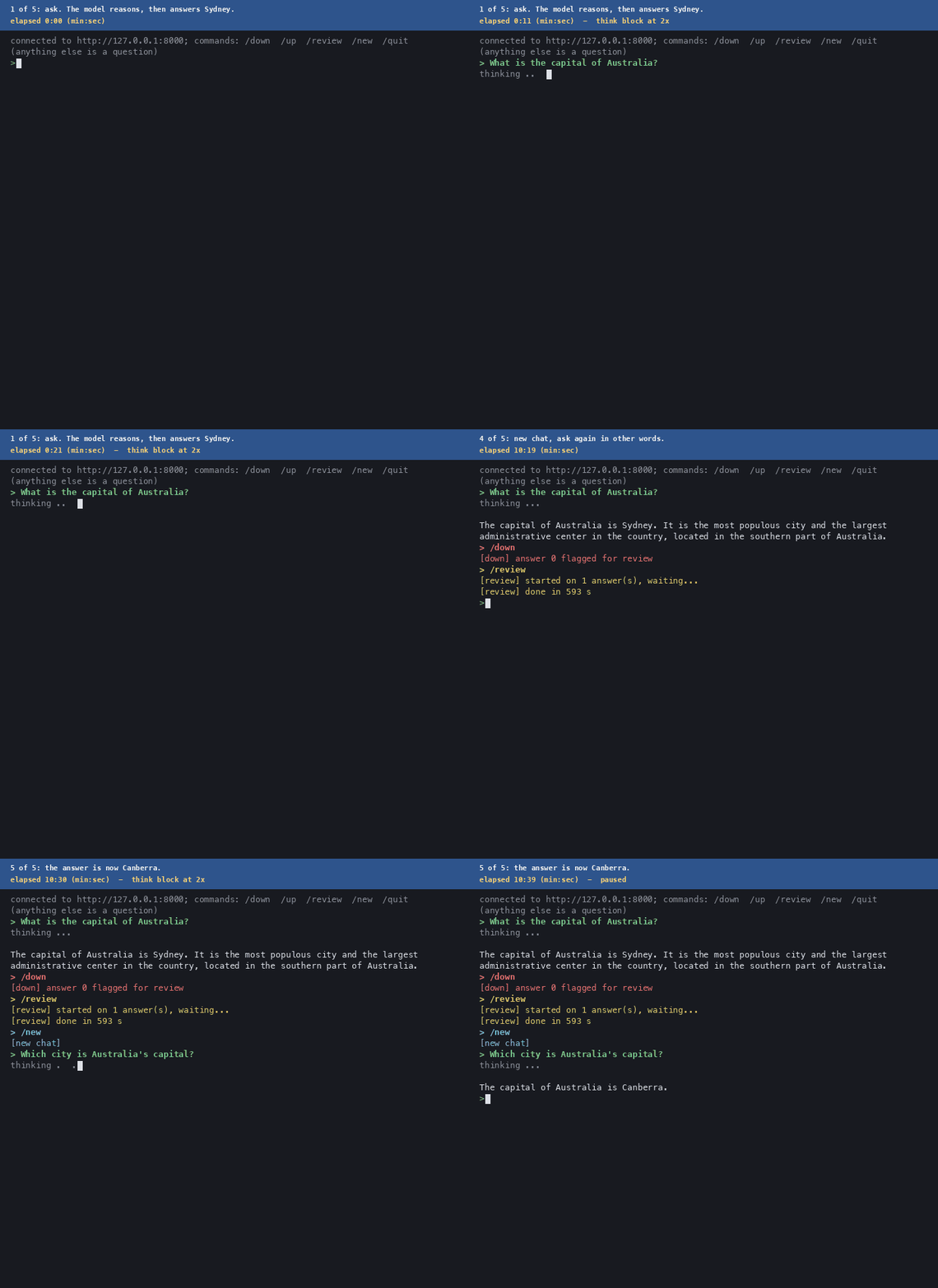
The terminal client shows the loop end to end, with the server running in another window:
- Ask a question the model gets wrong.
What is the capital of Australia?It reasons for a paragraph and answers Sydney. - Type
/down. - Type
/review. The node looks the question up in its document store, reads the passage, writes a corrected answer, trains on it in the background, and keeps the update only if its own re-asks agree; the client reports when it is done. - Type
/newand ask again in other words:Which city is Australia's capital?
Show the model's reasoning as it streams
 Both recordings are the same run with identical frame timing; the one above hides the reasoning behind a "thinking ..." line.The recording above is one run of exactly that sequence on a freshly
started server, sped up where marked, with the elapsed real time shown
throughout; the only cut is the ten-minute review wait, marked on the clock.
docs/demo.mp4 and docs/demo-thinking.mp4
are the two recordings as video. Step 4 comes out right when
step 3 kept an update; the write-up in results/ has
the numbers across five facts and sixteen sessions.
Run it
Python 3.13+. Apple Silicon for the server and evaluation harness; any CUDA
GPU for the self-repair loop through scripts/colab/.
git clone https://github.com/ible-ai/adaptible && cd adaptible
python -m venv .venv && .venv/bin/pip install -e .
.venv/bin/python -m adaptible.local                      # server at http://127.0.0.1:8000
.venv/bin/python -m adaptible.cli                        # in another terminal: ask, /down, /review, /new
PYTHONPATH=. .venv/bin/python scripts/cycles_mlx.py      # the self-repair loop
.venv/bin/python -m adaptible.eval --subset 20 --shuffle --no_browser   # baseline / train / re-measure
scripts/colab/adaptible_cycles.ipynb runs the loop on a free Colab T4 and
resumes across sessions. Module READMEs under adaptible/_src/ document
endpoints, flags, and metrics. Model-free tests:
python -m unittest adaptible.tests.classes_test adaptible.tests.api_test \
    adaptible.tests.local_test adaptible.tests.paths_test adaptible.tests.eval_test \
    adaptible.tests.autonomous_test adaptible.tests.cli_test adaptible._src.revise.revise_test
Layout
adaptible/_src/_llm.py        StatefulLLM: generation, LoRA training, loop breakers
adaptible/_src/revise/        conversation -> training example, loss masks
adaptible/_src/local/         FastAPI server
adaptible/_src/cli.py         terminal client
adaptible/_src/eval/          dataset, evaluation harness, meta-learning, reports
adaptible/_src/autonomous/    learning from web search against the model's beliefs
scripts/cycles_mlx.py         self-repair loop (MLX)
scripts/colab/                the same loop in PyTorch, Colab notebook
scripts/cycles_results.py     run log -> tables and plot
results/                      write-up and data
License
Contact for information.